

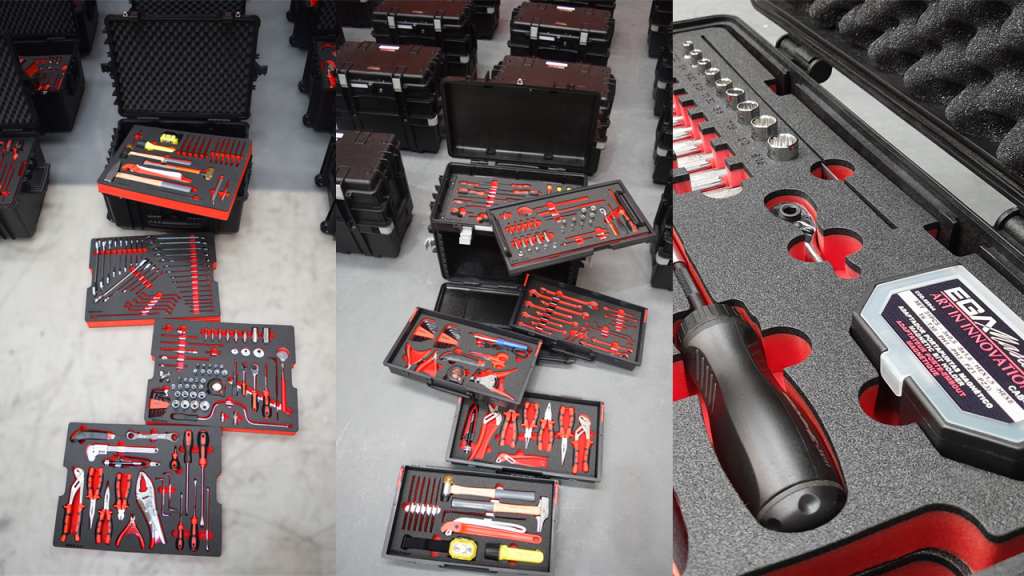
In the world of aircraft maintenance, having the right tool kit is not only a matter of efficiency, but of safety. Each specialty—whether it's B1 (mechanics), B2 (avionics), or D-Check (major maintenance)—requires a specific set of tools tailored to its duties. Below, we look at the key differences between these kits.
Tool Kit B1: The Mechanical Heart
B1 technicians are responsible for structural maintenance, engines, hydraulics, tires and landing gear. Therefore, its kit includes:
- Calibrated torque wrenches
- Pliers, screwdrivers and combination wrenches
- Cutting and riveting tools
- Measuring equipment (gauges, micrometers)
- Tools for work on engines and hydraulic systems
This kit must be robust, portable and sturdy, as working on the runway and hangars demands durable and versatile tools.
Toolkit B2: Electronic Precision
B2 technicians specialize in electrical, electronic, and navigation systems.
Their kit focuses on accuracy and diagnosis:
- Digital Multimeters and Portable Oscilloscopes
- Wire Crimping and Stripping Tools
- Communication and navigation system test equipment
- Precision screwdrivers and anti-static tweezers
- Diagnostic Software and Devices
Electrostatic safety (ESD) is key, which is why many tools are designed to protect sensitive systems.
D-Check Toolkit: Heavy Maintenance
The D-Check is the most comprehensive inspection of an aircraft, carried out every 6-10 years. It requires a much broader and more specialized kit:
- Non-destructive inspection (NDT) equipment: ultrasound, eddy currents, penetrating liquids
- Hydraulic and pneumatic tools
- Access platforms and elevators
- Calibration and Alignment Equipment
- Manufacturer-specific tools (OEM)
This kit is not individual, but is part of the hangar equipment, managed by the heavy maintenance department.
Each type of technician needs tools adapted to their specialty. While the B1 and B2 kits are personal and portable, the D-Check involves a complete infrastructure.
Choosing the right kit not only improves efficiency but ensures the safety of air operations.