

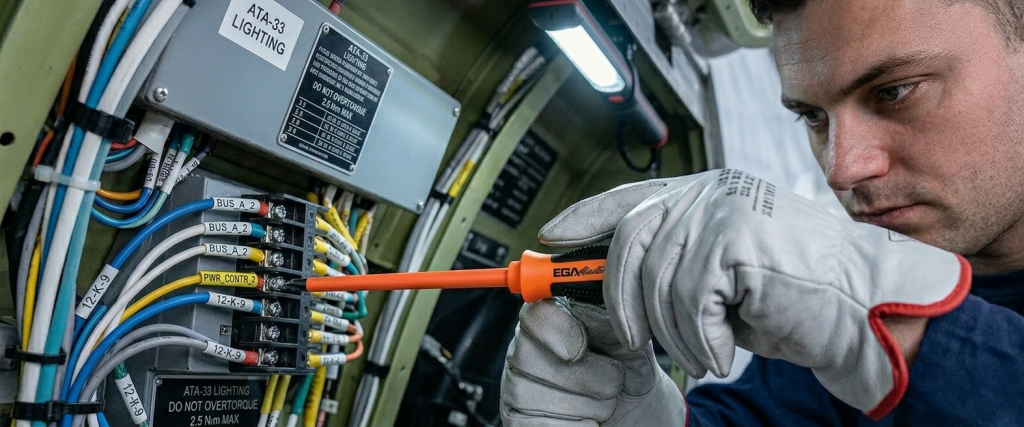
MRO is not a "no-risk" environment because it is on the ground
Aviation MRO (Maintenance, Repair & Overhaul) does not operate in a safe environment simply because the aircraft is grounded.
It operates on energized, complex, and critical systems.
A modern aircraft is, in essence, an advanced electrical grid: generation, distribution, avionics, and interconnected systems designed to ensure airworthiness in any condition.
And that's where the real challenge begins.
Tolerance for electrical failure in aviation is zero
The aeronautical authorities are categorical:
Any damage to wiring or electrical components cannot be tolerated, no matter how minimal it may seem, as it directly compromises the reliability of the system.
This is not a recommendation. It is an operational principle.
During maintenance, inspection, or repair, problems such as:
Critical faults identified in aeronautical electrical systems
- Damaged, poorly supported, or degraded wiring
- Overheated or discolored connections
- Insulation failures or unsafe proximity to ground
- Loss of continuity or poor grounding
- Components with signs of arc flash or corrosion
All these factors are direct indicators of risk in airworthiness.
Where do electrical hazards appear in MRO?
Electrical hazards in the MRO environment are no exception. They are an inherent part of the job.
Typical electrical hazard situations
- Interventions on energized systems
- Functional Testing and Electrical Diagnostics
- Installing, connecting, or disconnecting equipment
- Handling of wiring and avionics systems
Types of electrical hazards
- Contact electrocution with active systems
- Arc flash with extreme thermal release
- Fires resulting from electrical failures
- Electrostatic charge build-up (critical risk in combustible environments)
These risks can lead to damage to equipment to serious incidents with personnel or aircraft.
Increasing electrification increases criticality
Modern aircraft incorporate:
- Higher density of electrical systems
- Advanced avionics augmentation
- More complex data and communication networks
This implies a clear reality:
- More electrical systems = more potential points of failure
- More interconnection = greater impact in the event of an incident
In addition, the sector has shown that faults in wiring or electric arcs have been present in real incidents over time.
The MRO's Real Role: Staying Ahead of Failure
MRO is not about repairing.
It consists of preventing the failure from coming into existence.
The reliability of the electrical system depends directly on:
- The quality of maintenance
- The technical knowledge of the staff
- The ability to inspect and detect early
As reflected in the technical literature, the performance of the electrical system is directly linked to the maintenance practices applied.
The key question is not whether the risk exists
In aviation, the question was never:
Are there any electrical hazards?
The real question is:
How are they identified, controlled, and removed before they scale?
Systems, tools and risk control
In critical environments like MRO, security doesn't just depend on procedures.
It depends on:
- Structured work systems
- Certified tools for electrical environments
- Rigorous intervention protocols
- Zero-Failure Technical Culture
MRO as a pillar of aviation safety
MRO is one of the invisible pillars of aviation.
Because it ensures that each aircraft:
- Maintain your reliability
- Meet regulatory standards
- Trade without compromising safety
And in this context, controlling electrical risk is not an option.
It is an indispensable condition.
References
- Federal Aviation Administration (FAA). Aircraft Electrical Systems – Inspection and Care (AC 43.13-1B, Chapter 11).
[faasafety.gov] - Federal Aviation Administration (FAA). Electrical Safety Programs (FAA Order 3900.19B).
[faa.gov] - SKYbrary Aviation Safety. Incidents Related to Aircraft Wiring Damage and Electrical Arcing.
[skybrary.aero] - Safety Gear Insights. Managing Mechanical and Electrical Hazards in Aircraft Maintenance.
[safetygear... sights.com]