

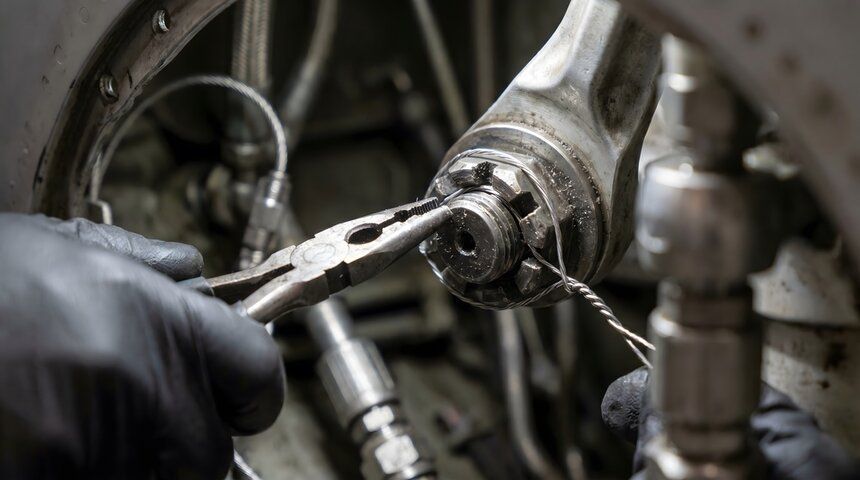
The role of stainless steel in the aeronautical sector
Aviation is one of the most demanding industrial environments in the world. Materials and tools must withstand extreme conditions of temperature, humidity, chemicals and fatigue cycles, while always maintaining maximum reliability. Stainless steel is widely used in aircraft components precisely because of its corrosion resistance, durability and mechanical stability.
In the field of aeronautical maintenance (MRO), these properties are transferred directly to the tool: less degradation, longer service life and less operational risk.
When are stainless steel tools necessary?
Corrosive environments and harsh conditions
Aircraft operate in environments where corrosion is a critical factor:
- Coastal airports (salinity)
- Exposure to chemical fluids (fuel, de-icing)
- High humidity in hangars
Stainless steel creates a passive layer that prevents rust and extends the life of materials. Therefore, stainless steel tools are especially valued in these scenarios.
Applications where reliability is critical
In aviation, failure is not an option. The tools must ensure:
- Precision in maintenance
- Stability over time
- Reduced contamination in critical components
In addition, the regulatory framework (EASA, FAA) requires traceability, quality and control of tooling at all times.
Types of stainless steel applicable to tools
AISI 420: operational robustness
The AISI 420 stands out for its hardness and mechanical resistance, being ideal for intensive use in general maintenance. It offers an alternative to carbon steel with better corrosion performance.
AISI 304: control and cleaning
The non-magnetic AISI 304 is suitable for environments where contamination or interference must be avoided, such as avionics or sensitive systems.
AISI 316: highest demands
AISI 316 provides superior resistance to chlorides, making it the optimal choice in highly corrosive environments, such as coastal airports or offshore conditions.
A strategic need, not a universal one
Stainless steel tools are not a substitute for all materials (such as titanium or non-sparking alloys), but they do fill a critical niche within aeronautical MRO. Its value lies not only in the material, but in its correct selection according to the environment of use.
In this sense, the winning approach is not to sell "stainless tool", but to offer:
The right tool for every aeronautical maintenance condition.
This positioning connects directly with the demands of the sector: safety, durability and regulatory compliance.
Sources
- Federal Aviation Administration (FAA) – Corrosion Control for Aircraft [faa.gov]
- Outokumpu – Stainless Steel in Aerospace & Aviation [outokumpu.com]
- Stainless Today – Role of Stainless Steel in Aerospace Engineering [stainlesstoday.com]
- Kalapurna – Aerospace Guide to Stainless Steel Specifications [kalapurna.com]
- JISCO – Stainless Steel for Aerospace Industry [jiscojude.com]